
When Small Issues Become Critical: AxiomCode x Spring Cloud Case Study

Critical Risk Can Start from Small Weaknesses
Critical vulnerabilities do not always start as obvious, high-severity bugs. In large codebases, they often emerge when several smaller weaknesses interact across different parts of the system and different code quality dimensions. One issue changes how input is interpreted. Another issue trusts that input too early. A third issue fails to handle the unexpected state safely. Together, they create a cascading failure that can become much more serious than any single alert appears on its own.
This 9.8/10 critical issue case in Spring Cloud Config Server shows that pattern clearly. A maintainability weakness compounded by a security weakness causes a reliability failure. Individually, these mid- to low-severity issues look like noise in large codebases, but together they pose risks of secret exposure and repeatable service disruption, with issues remaining active for 12 years.
How the Cascading Failure Created the CVE
The issue begins with an attacker-controlled label in an unauthenticated HTTP GET request. Normally, a raw / cannot remain inside a single Spring path variable because the framework treats it as a path separator. But in this case, the application accepted an encoded form: (_). An attacker could send a label such as ..(_)..(_)nonexistent, which would survive routing as one path segment. Later, Environment.normalize() decoded (_) into /, turning the label into ../../nonexistent.
The problem was not simply that decoding happened. The problem was that the decoded result was trusted without validation. After decoding, the label could contain real traversal sequences like ../, but the system did not block it before passing it deeper into the application. This made the input-decoding issue the root cause of the chain.
From there, the decoded label reached SVN path construction. The application built a filesystem path using the attacker-controlled label, but did not prove that the final resolved path stayed inside the intended SVN working directory. That turned the decoded input into a path traversal issue. In other words, a value that looked safe enough to pass through routing became a filesystem escape after normalization.
Once the path traversal state existed, two different impacts became reachable.
The first impact was file and secret exposure. If the escaped path pointed to an existing readable file, the server could return that file over HTTP. The risk could become even more serious because Spring Cloud Config Server may process returned files as configuration text. If a file contained placeholders such as ${spring.datasource.password}, those placeholders could be resolved against live application configuration. That means a path traversal issue could escalate from file access into secret exposure.
The second impact was repeatable service disruption. If the escaped path did not match a valid SVN label structure, the application could throw NoSuchLabelException. The controller handled some resource errors, but it did not safely handle this exception. As a result, the exception could propagate and return HTTP 500. Because the endpoint was unauthenticated in this case, an attacker could repeatedly trigger the failure.
The full chain is:
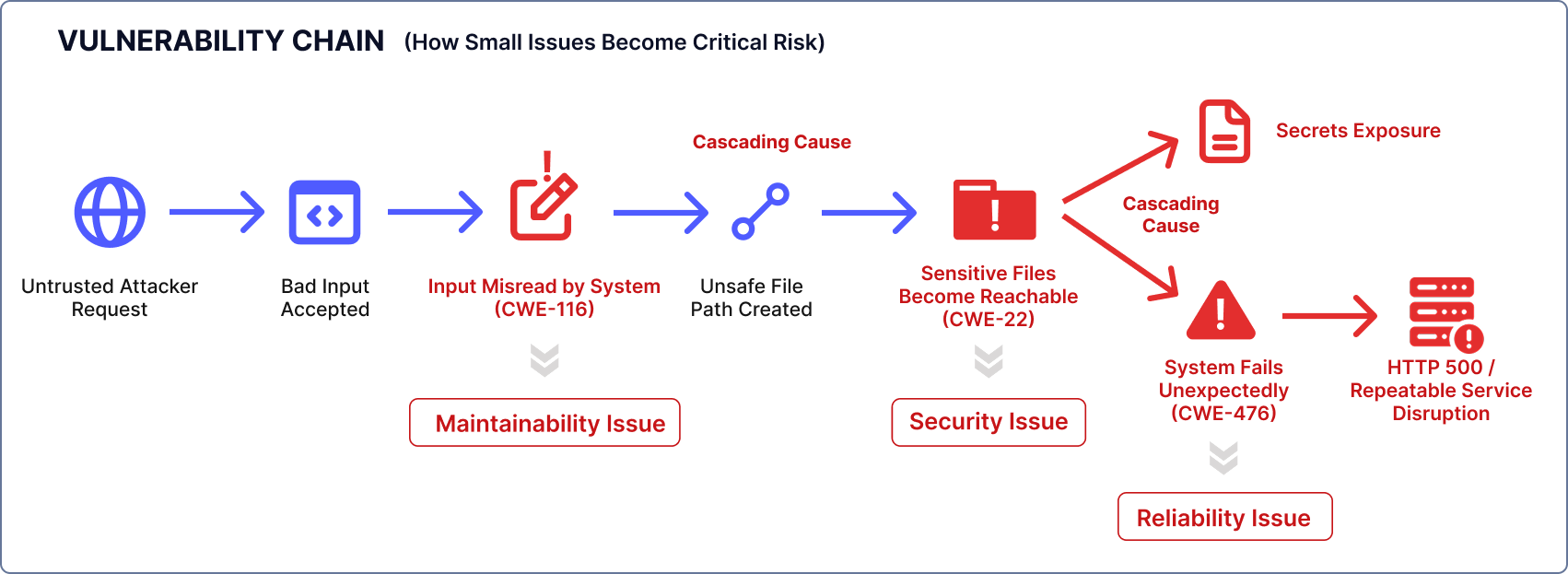
This is why the case is important. Security teams may see these as separate issues: an input normalization concern, a path construction issue, and an exception-handling problem. But the real risk comes from how they connect. The decoding weakness creates the unsafe state. The missing containment check turns that state into filesystem reachability. The exception-handling gap turns the same state into service disruption.
How AxiomCode Prioritizes the Root-Cause Fix
AxiomCode helps by tracing the full failure chain instead of treating each finding as an isolated alert. In this case, AxiomCode followed the attacker-controlled label across the controller, normalization logic, repository lookup, and SVN path construction. It identified that the input-decoding weakness enabled path traversal, and that the path traversal could lead to both file/secret exposure and HTTP 500 failure.

This also helped clarify the real downstream issue. The engine initially flagged a crash condition as CWE-476, which refers to null pointer dereference. But validation showed that the actual failure was not a true null pointer dereference. The real mechanism was an unhandled NoSuchLabelException leading to HTTP 500. For remediation, this distinction matters: the team should fix the root cause and the real failure path, not chase the wrong downstream symptom.
The highest-priority fix is post-decode validation. Once (_) is decoded into /, the application should immediately validate the decoded label and block traversal sequences before the value reaches filesystem path construction.
The second priority is canonical path containment. Even if earlier validation misses something, the filesystem layer should resolve the canonical path and confirm that it remains inside the intended SVN working directory.
The third priority is safe exception handling. NoSuchLabelException should be handled explicitly and returned as a controlled client error, not allowed to become a repeatable HTTP 500.
Finally, placeholder resolution should only happen after the application proves the file came from a trusted repository path. Files outside the trusted boundary should never be treated as configuration templates.
This case shows why modern AppSec needs more than finding individual bugs. The most dangerous risks often emerge between findings, where small weaknesses compound into system-level failure. AxiomCode is designed to reveal those hidden chains, explain the real impact, and help teams prioritize the fix that breaks the chain at the root cause.
Related Articles:

