AxiomCode x Keycloak Case Study

Serious vulnerabilities are often not caused by one isolated coding mistake. They emerge when weaknesses in different parts of a system interact and amplify one another. CVE-2026-9083 in Keycloak is a clear example. A realm administrator with the manage-realm role could submit an arbitrary filesystem path when creating a key provider component. Keycloak would attempt to load that path, and differences in the resulting behavior could reveal whether files existed and were readable by the Keycloak process. At first glance, this looks like a standard path traversal issue. In reality, the critical risk came from a cascading failure across security and maintainability dimensions.
The Risk
The vulnerable workflow began with a legitimate administrative function. Keycloak allows realm administrators to configure key provider components and specify a keystore location. The problem was that this user-controlled path could reach a filesystem-loading operation without sufficient validation, canonicalization, or directory restriction. This created a path traversal condition classified as CWE-22. The attacker did not necessarily need to download the target file directly. Instead, they could observe how Keycloak responded to different filesystem paths. A readable file, an inaccessible file, and a nonexistent file could produce different outcomes. Those differences turned the application into a filesystem oracle. By repeatedly testing likely paths, an attacker could map the server’s file structure and identify high-value targets such as configuration files, credentials, private keys, or database settings.
How the Cascading Failure Created the CVE
The vulnerability was not simply “an unsafe path.” The first weakness allowed attacker-controlled input to reach an arbitrary filesystem location. The second weakness exposed information through downstream error-handling behavior.
The complete chain was:
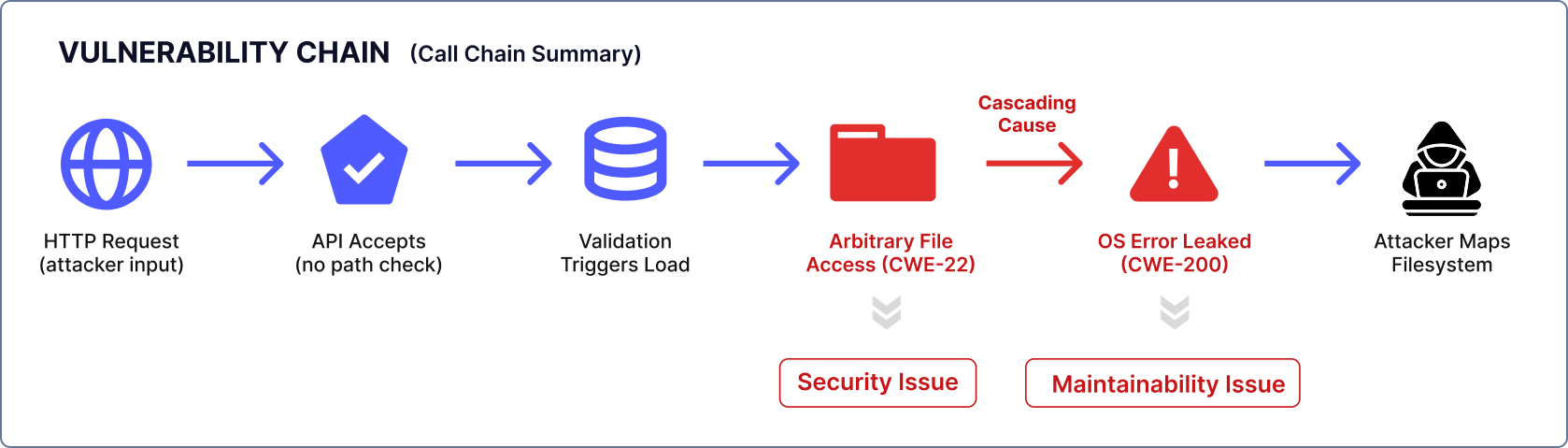
The path traversal weakness, CWE-22, made the filesystem reachable. The information exposure weakness, CWE-200, made the result observable. Each issue was serious on its own, but their interaction created the exploitable vulnerability. An attacker could use one weakness to trigger the other and gain knowledge about the underlying environment. Traditional tools often report these as separate findings. That can hide the real impact because the risk only becomes clear when the full execution chain is reconstructed.
Why This Was Also a Maintainability Failure
The issue also reflected a maintainability weakness in the system design. A user-facing configuration parameter was directly connected to a low-level filesystem operation. There was no strong, centralized abstraction defining where keystores could be loaded from or how filesystem failures should be handled. As a result, the security policy was distributed across multiple components: input handling, path resolution, file loading, and error reporting. Developers reviewing only one function might not recognize how the pieces interacted.
This kind of fragmented control makes the system harder to audit, harder to change safely, and more likely to reintroduce similar vulnerabilities. The maintainability weakness therefore compounded the security weakness by allowing critical assumptions to remain implicit and scattered throughout the codebase.
Why an Isolated Fix May Not Be Enough
A scanner might recommend sanitizing the input or suppressing the error message. Both actions could help, but neither necessarily fixes the root cause. A blacklist-based path check may be bypassed through path normalization, symbolic links, absolute paths, or platform-specific behavior. Suppressing one exception may also leave other observable differences in place. The real issue was the missing boundary between realm-level configuration and host-level filesystem access.
A complete remediation should validate and canonicalize the submitted path, restrict the resolved location to approved directories, prevent arbitrary host paths from being selected, and ensure that failure responses do not reveal sensitive filesystem details.
How AxiomCode Reconstructed the Failure Chain

AxiomCode analyzed the application as an interconnected system rather than a collection of isolated alerts. The verification engine built a code property graph representing the relevant data flow, control flow, call relationships, and filesystem interactions. It verified that user-controlled keystore input could propagate into a sensitive file-loading API. This confirmed the CWE-22 path traversal condition.
AxiomCode then traced the downstream behavior of the filesystem operation and identified that different outcomes could expose information about the target path. This connected the arbitrary file access to the CWE-200 information leak. Instead of reporting two unrelated weaknesses, AxiomCode reconstructed the complete cascading failure and explained how the chain became exploitable.
The result was not only a vulnerability label. It was a verified explanation of how an application-level administrator could cross a filesystem boundary, trigger observable operating-system behavior, and map the server environment.
Prioritizing the Root-Cause Fix
Once the complete chain was visible, the remediation priority became clearer. The earliest controllable point was the validation and path-resolution logic before the keystore-loading operation. Fixing this trigger function could break the chain before arbitrary file access occurred.
AxiomCode therefore prioritized enforcing an approved keystore boundary rather than treating the information leak as the only issue. This root-cause approach prevents the unauthorized filesystem operation itself, reduces reliance on scattered downstream checks, and lowers the chance that the same vulnerability will reappear through another call path or error condition.
From Vulnerability Alert to Actionable Remediation
CVE-2026-9083 shows why vulnerability severity cannot always be understood from an individual finding. The path traversal became dangerous because downstream error behavior converted it into information disclosure. The information disclosure persisted because configuration, filesystem access, and error handling were too tightly coupled. By tracing the complete chain, AxiomCode helps security and engineering teams understand not only what the vulnerability is, but why it is exploitable, where the root cause lies, and which fix will break the chain with the least risk of introducing new problems. That is the difference between detecting a weakness and understanding how to eliminate it.
Related article:
Red Hat Report